


 share on Buffer
Read below the official design story or check the complete image gallery.


From the official Press Release:
Design
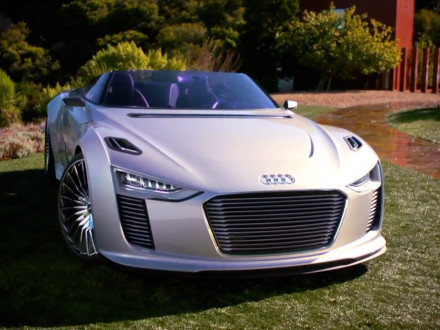
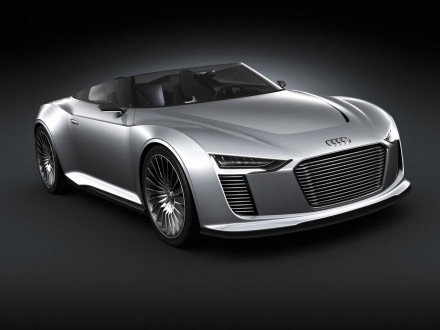
 The Audi e-tron Spyder features the most advanced and consistent evolution of the current Audi design language, while also providing initial hints at the design language of future Audi sports cars.
It reinterprets the most important design elements that already characterized the previous e-tron concept vehicles.
This also ensures the necessary formal differentiation to the purely electric-powered Audi e-tron shown at the 2010 Detroit Motor Show.
1.81 meters (5.94 ft) wide, just 4.06 meters (13.32 ft) long and only 1.11 meters (3.64 ft) in height: these are the classic proportions of an open, high-performance sports car.
 Compared to the coupé concept car in Detroit, the length and width have increased by 13 cm (5.12 in) and 3 cm (1.18 in), respectively, to underscore the sporty aspiration of the design.
This further enhanced the powerful and compact overall appearance that characterizes both vehicles and links them to the R8.
Due to the short wheelbase of only 2.43 meters (7.97 ft) – 22 cm (8.66 in) shorter than that of the R8 – the body of the e-tron Spyder looks extremely stocky.
 In a homage to motor sports, the frameless side glass surfaces taper downward toward the rear.
They form a unit with the windshield, which is strongly bowed and inclined like the visor of a helmet.
Another element borrowed from race cars characterizes the hood: the wide central air inlet, whose curve further accentuates the dynamics of the car’s front end and provides a visual and functional link to the Audi R8 LMS customer race car.
The carbon application that is mounted flush in the front and side windows and wraps completely around the glass testifies to the design and manufacturing expertise that went into the car.
 The front and the silhouette of the e-tron Spyder are characterized by a sharp, sweeping line that immediately identifies the two-seater as an Audi.
The sharply tapered front end lends the Audi e-tron Spyder show car a distinctly wedge-like basic shape.
The trapeze of the single-frame grille dominates the distinctly wedge-shaped front end and is flanked by two large air intakes.
They serve as cooling intakes for the electric drive system and also for the TDI engine at the rear of the vehicle.
Above, the grille merges into the flat strips of the adaptive matrix beam headlight modules with their three-dimensional clear glass covers that follow the contour of the functional elements.
All light units use ultra-efficient LED technology. As with the R8 and the e-tron sports car concept cars, the trademark four rings are located above the single-frame. Beneath the trademark is the charging station for the batteries. The rings disappear beneath the front hatch, exposing not just the charging plug but also a display showing the charge state and a map graphic indicating the current electric range.
 The 20-inch wheels take the blade design of the first e-tron show car and refine it into a three-dimensional turbine design.
They combine aluminum and carbon materials into an aerodynamic and complex design, made of 66 individual components.
The flanks sport familiar contours in a new form.
Unusually sharply defined edges frame the smooth side surfaces while simultaneously separating horizontal from vertical areas.
The shoulder line frames the lines of the strongly contoured wheel wells even more distinctly than in the Audi R8 and combines them with the upper edge of the vehicle body. Particularly when viewed from the back, the e-tron Spyder appears even more pronouncedly horizontal and more strongly oriented toward the road.
An impression that is also created by the characteristic sills with a new cut and is picked up by the spoiler and diffuser at the front and rear of the car. Carbon elements borrow from motor sports to set special accents here as well. Carbon is also used on the engine cover in the rear and in license plate and lighting frame, which also includes the air outlets below the lateral light units.
The contrast of materials is reminiscent of a race car. The essential functional elements of the chassis and the vehicle body are done in carbon, while the body as a cover sports a classic paint finish. This illustrates the formal “shell-and-core” principle that defines the e-tron Spyder particularly clearly.
Thanks to an opening in the hood, even the longitudinal TDI mid-engine is a visible technological element surrounded by matt and glossy carbon surfaces, aluminum and leather. This combination of materials links the exterior with the interior of the vehicle.
Behind the seats are two cowls that gradually taper toward the rear and also flank the opening for the TDI engine and the implied cooling fins of the engine cover.
They also contain the normally hidden rollover bars, which like in the production R8 Spyder shoot up within milliseconds and lock into place in the event of an emergency.
Interior design
 Visual and functional references to the fundamental concept of lightweight construction characterize the purist interior design.
They establish a connection between proven Audi genes and new formal hallmarks. Typical for the Audi design idiom is the reduction of the architecture, controls and information output to the essentials in favor of a tidy overall impression.
The slim dash has a curve that extends laterally into the door panels.
With no need to allow for a transmission, shifter and cardan tunnel, the designers again took advantage of the opportunity to create a particularly slim and lightweight center tunnel and convex, arching center console for the e-tron Spyder with hybrid drive.


The only control element other than that of the MMI is the flush-mounted selector lever for the automatic transmission, which extends upward from the tunnel when the vehicle is started.
 The cockpit of the Audi e-tron Spyder is also oriented toward the driver – a further characteristic Audi trait.
Instead of the classic instrument cluster, the concept car is equipped with a large, display with integrated MMI functions and flanked by two round dials.
The MMI can be controlled via a touch-sensitive control panel on the steering wheel – an element inspired by modern smartphones.
It can also be controlled via the MMI control unit (MMI touch) on the center console.
The steering wheel itself is clearly flattened off at both the top and bottom, in a clear reference to motor sport. Speed is displayed in digital form only.
 The dial instrument with information about the drive system can be chosen via the menu item “Drive.”
Besides information about the speed, the revs of the combustion engine and the electric drive, the central display also provides all of the key information from the infotainment and navigation systems.
Characteristic for the concept of the Audi e-tron Spyder is the near total elimination of switches and components such as the ignition.
The climate control unit is located to the right above the steering wheel. The display provides temperature and ventilation information. Again drawing inspiration from a smartphone, the system is operated by means of a touch-sensitive control panel.
The equally racing-inspired lightweight bucket seats combine excellent lateral support with comfort. Contrasting colors and stitching delineate the various zones of the interior. The colors and the high-quality materials combine elegance and sportiness.
(Source: Audi)





Comments