


 share on Buffer
Developed by Tata’s design centers in India, UK and Italy, the Megapixel follows the Tata Pixel presented at Geneva in 2011 and proposes the company’s vision for a sustainable and versatile city car, while giving indications on the brand’s design direction for the next models.


The Megapixel is characterized by compact dimensions combined with a spacious interior that accommodates four adults with luggage and an eco-friendly drivetrain, with hub-motors and a range extender.


It offers a range of up to 900 km (with a single tank of fuel), CO2 emissions of just 22 gm/km and fuel economy of 100 km / liter.


Even if the car was developed as a global model, the design took inspiration from Indian colors, graphic themes and materials.

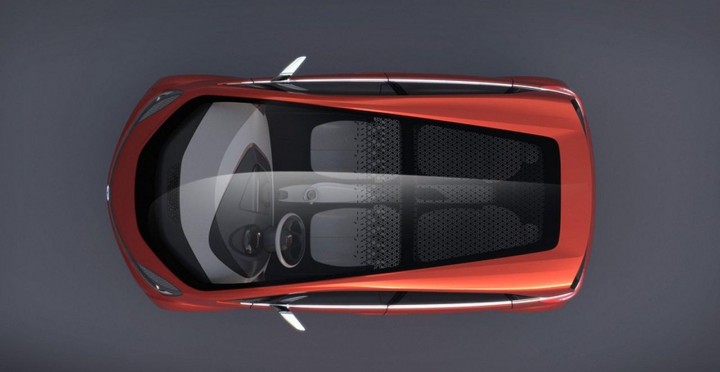
The Megapixel has a single-box layout, with a short front end, and a sweeping silhouette that ends with a floating C-pillar.
 The car’s profile is underlined by the chromed trim that runs along the belt line, and from which originate the sleek side-view camera supports.
The car has a strong, dynamic stance, thanks to the bold wheelarches, the minimal overhangs and the accelerating character lines that define the surfaces of the flanks.
Among the main exterior features are the traditional ‘Jaali’ pattern used tridimensionally on the bumpers and the panoramic roof and the double-sliding door system combined with the B-pillar less design.


The interior has an essential and clutter-free look, with floating front seats and an advanced human machine interface (HMI) with built-in touchscreen and connectivity for smartphones and mobile devices.


Below we report selected information from the official documents. Additional details can be found on tatamegapixel.com.


Design Story
 The Tata Megapixel is designed to express the energy and dynamism seen in Contemporary Design in India today.
The design language of Megapixel , while inspired from traditional Indian Architectural and design details, is completely Global in its reach and appeal, comfortable in New York, London or Mumbai.
The traditional Indian ‘Jaali’ for instance has been used in a 3 dimensional way in the air intakes on the bumpers, or the A/C vents, giving it that modern, unexpected twist.
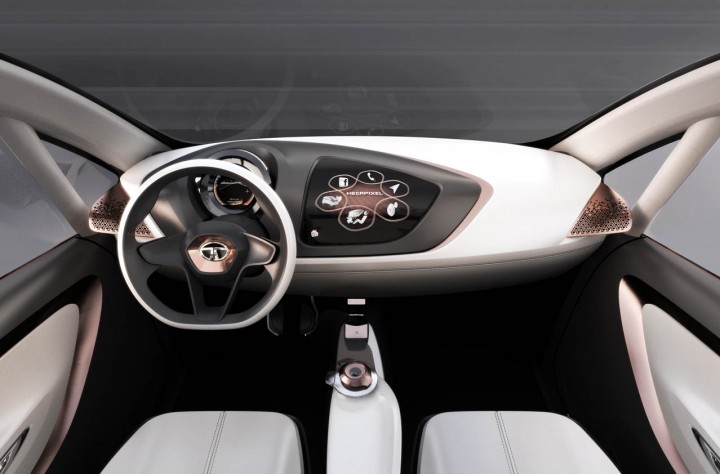 The Rose Copper details in the Interior which are derived from tradition India metal craft are another use of a very traditional Indian material.
The juxtaposition of technical and natural materials also reflects perfectly the place India occupies today in the Global context, a mix of the modern with the traditional.
The integrated lamp and grille graphics sweep back over the front wheel arches to render a dynamic front end. It is echoed on the panoramic roof, creating a harmony between sun & shade and sense of interior space.
The floating C-pillar and wrap-around belt line finisher integrate with the sculpted body surface, flowing freely to the rear and encapsulating the 5-spoke wheel design.


The wide, single piece front ‘mask’ give the car a presence usually reserved for much larger cars. The single belt line which sweeps from the front quarter glass all the way around to the tailgate, visually stretch and lengthen what is otherwise a car with very compact dimensions.
 The floating seats and patterned panoramic roof give a sense of lightness to the passenger cabin.
The double sliding front and rear doors, afford unhindered access to a warm and welcoming interior space which is designed to be minimalistic and clutter free.
The front seats are cantilevered on the central tunnel, releasing floor space for additional storage.
Light leather trims and rose metal details accentuate the mix of tradition and technology.
(Source: Tata Motors)


I can feel it
Tata is trying and this is good, really good. I saw this concept in Geneve motor show and can say nice try, but it was clear how bad materials used for it and some touches of biginners deigns any one can notice, and these sketchs and style of rendering confirmed my point of view. Really that is making me wonder why a car maker like Tata is not trying to hire an experienced designers to make a revolution to the brand image?